Demo · Stream Predictor
Live Space + real interface screenshot.
Open the Space to try entering Form 3 marks and get a stream recommendation.
Open Stream Predictor Space ↗Screenshot frame
This is AuraStudy: it helps a Form 3 student choose an SPM stream using real school data, then gives a weekly study plan that adjusts to how the student feels about each subject.
We just went through stream selection ourselves, and we have seen friends regret their choices. It matters to us and to our community: students choose at 15 with little data-based guidance, then study without structure.
We interviewed Form 4 and Form 5 students and teachers, and compared existing tools. We have not found a Malaysian tool that combines real school-data stream prediction with weekly adaptive planning. That is why we built one: real school data for accuracy, fixed rules for the plan, and AI only to explain.
Enter 8 Form 3 marks (0 to 100) and get a suggested stream: Science, Semi-Science or Art.
How it is built: Ridge regression, one formula per stream, trained in Google Colab on 400+ real students from our school. We compared Ridge, Random Forest and KNN with cross-validation, and Ridge had the lowest error for all three streams. It estimates SPM merit for each stream and takes the highest. If the 8 marks total below 200, it recommends ART. Groq only writes one explanation sentence. It never chooses the stream.
Honest limits: an estimate, not a promise. It predicts merit out of 90, as Ko-kurikulum is not included. The final decision belongs to the student, parents and counsellor.
After each session, students rate understanding and focus from 1 to 5. Weak subjects get more time next week, and strong ones get less. In our survey, students finished about 67% of their plan.
How it works: fixed rules set study time from the mark (under 40: 150 min, 40 to 64: 120, 65 to 79: 90, 80+: 60). Average rating 2 or less: +30 min. Average 4 or more: −15 min, never below 45. Groq only writes the feedback comments, and the plan is emailed as a PDF.
Why rules: AI cannot invent study times that do not match the student’s real marks.
Form 3 to Form 5 students preparing for SPM, especially those unsure which stream to pick or struggling to study alone.
We walked teachers and students at our school through the app. Teachers could spot students who mismatched their stream.
With 5-fold cross-validation, a typical prediction is about 5 to 8 merit points off. We also tested it on 156 new Form 4 students it never trained on, comparing the suggested stream with what they really chose: 54.5% agreement.
Semi-Science matches best (41 of 49). Science 21 of 42. Art 23 of 65, because many Art students are placed in Semi-Science. We say this openly: it is a recommendation, and we are improving it.
To build it: Claude built the app, and Gemini helped write and fix the backend and model code in Colab. Most of us are not strong coders, so we describe, test and fix, and we never paste API keys into AI chats.
Inside the app: a Ridge model predicts merit, and Groq writes explanations, feedback comments, and checks quotes. Budd tutors with hints. AI never chooses the stream.
We start at our own school, where the training data comes from. Then nearby schools, families, and districts. Business model: free basic for students, paid plans for schools and families.
Year 1: prizes and grants, school pilots, then a family premium tier in months 7 to 12 (basic stays free). Drag the sliders to play with our Year 1 targets.
Local tuition centres: at about 1,000 users we add referral links and co-branded study tips inside the app. We earn 10 to 15% commission on premium sign-ups we refer, and the centres get students who already want help. Year 2+: anonymised insights for districts.
Costs now: RM0 (Colab, Hugging Face, Firebase, Groq and Brevo free tiers). Growth steps: 200 users, stronger grants. 1,000 users, family premium and tuition partners. 5,000 users, district insights. No ads and no selling of student data.
Open the full app and play with the Stream Predictor, weekly planner, Dragon Egg and Budd.
Open AuraStudy 🐉Works best on phone or tablet
It guides the big decision of which path to take, and the daily discipline to follow it. Never studying alone.
Open AuraStudy 🐉Thank you!
It hatches and evolves as you study, so students keep showing up.
Budd is a study helper for Form 1 to 5. It gives hints and asks the student to try, instead of giving full answers.
Secret Oasis is a quote wall. Groq checks every student quote (APPROVED or REJECTED) before others see it.
One Ridge formula per stream (alpha 5.0). Ridge penalises very large weights, because subjects overlap and each stream has only 91 to 211 students. Marks are standardised, accuracy is checked with 5-fold cross-validation, and the model is saved as one .pkl file.
Science weights: Math 7.59 and Science 5.82 are the strongest. BM is −1.71, which is normal when subjects overlap. It does not mean BM hurts the student.
# app.py, POST /predict (simplified)
if any(m < 0 or m > 100 for m in marks):
return error_422()
merit = {s: models[s].predict(x) for s in STREAMS}
if sum(marks) < 200:
best = "ART"
else:
best = max(merit, key=merit.get)
sentence = ask_groq_to_explain(best) # Groq explains, never chooses
# app.py, POST /career-mapper
fallback = build_fallback_careers(stream, interests)
if not client:
return fallback
# Groq writes exactly 3 careers; each needs title, salary, path, insight
if len(valid_careers) >= 3:
return valid_careers[:3]
return fallback # the app never breaks if the AI fails
# budd_api.py, POST /budd
# Guide, don't hand out answers: hint ladder
# clarify -> recall concept -> first step -> check student's step
def _rate_ok(ip, limit=20, window=60): ... # 20 messages / minute
# app.py, POST /moderate
# Groq replies EXACTLY ONE WORD: APPROVED or REJECTED
temperature=0.0
return "APPROVED" if "APPROVED" in content else "REJECTED"
Recommendations, not decisions Budd guides, never answers No chat with strangers Only data we need
We built on free tiers and our school’s own data. Tap a card to see what each one does.
If we win prize money, it goes to hosting beyond the free tiers and a proper mobile app.
Live Space + real interface screenshot.
Open the Space to try entering Form 3 marks and get a stream recommendation.
Open Stream Predictor Space ↗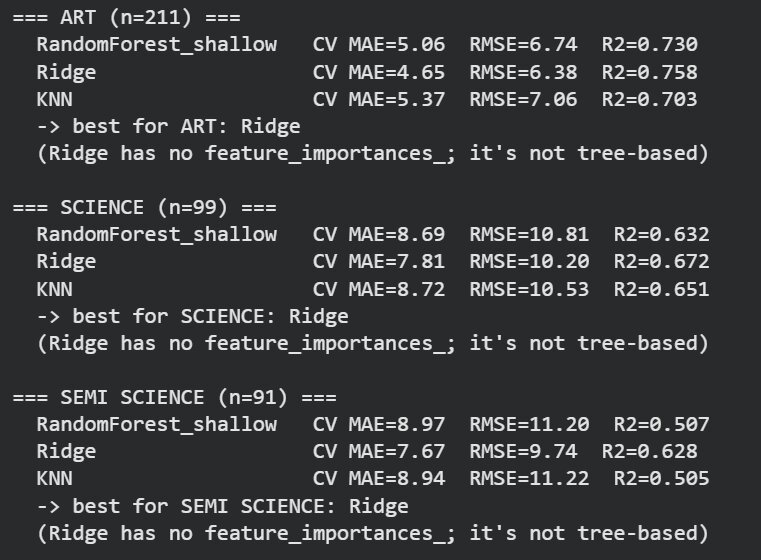
Updated weekly plan example generated by the Adaptive AI Study Planner.
Students rate understanding & focus → the plan adjusts next week. Plan is emailed as PDF.

After stream prediction, students can explore careers that match their stream and interests.
Groq generates 3 career suggestions (title, salary range, path, insight). Always has a safe fallback.
Open Career Mapper Space ↗